
Nightmares and Ancient Golems
Nightmares are spirits overtaken by their own anguish; Ancient Golems are the constructs named alongside them in the announcement.
Nightmares are what happens to a spirit in Xotecha when grief wins. ArenaNet's announcement explains the process in one paragraph: a spirit who lingers in anguish for too long risks being overtaken by their pain, which transforms them into beings of pure rage. That is the origin story of the DLC's main enemy type, and it is the reason the Order of the Moonless Night exists.
Ancient Golems are named alongside them. The announcement's feature line is Encounter Ancient Golems, battle powerful Nightmares, and uncover the secrets of the Cult of Odran, and the store page repeats the pairing: battle new foes and bosses including Nightmares and Ancient Golems. Two enemy families, one made of unresolved emotion, one made of old stone and older machinery.
Nightmares: the mechanic behind the monster
Most games with a "nightmare" enemy use it as a flavour word. Afterlife makes it a rule with a cause and an effect.
| Stage | What happens | Source |
|---|---|---|
| A spirit arrives | Lost souls flood the Unformed | Announcement |
| Grief lingers | The spirit cannot reconcile its tragedy or regret | Announcement |
| Pain takes over | The spirit is overtaken by its anguish | Announcement |
| The result | It becomes a being of pure rage: a Nightmare | Announcement |
That chain has a design consequence. If Nightmares are made from grief, then a Nightmare is not evil; it is a person who could not let go. The announcement frames the Order as shepherds rather than monster hunters, which means the enemy you fight is also the failure state of the job you are helping with.
It also explains why the surge matters. Throngs of lost souls have flooded the Unformed, and the Order is missing an elder. More grief arriving means more Nightmares, faster than the Order can shepherd them.
Ancient Golems: the other enemy family
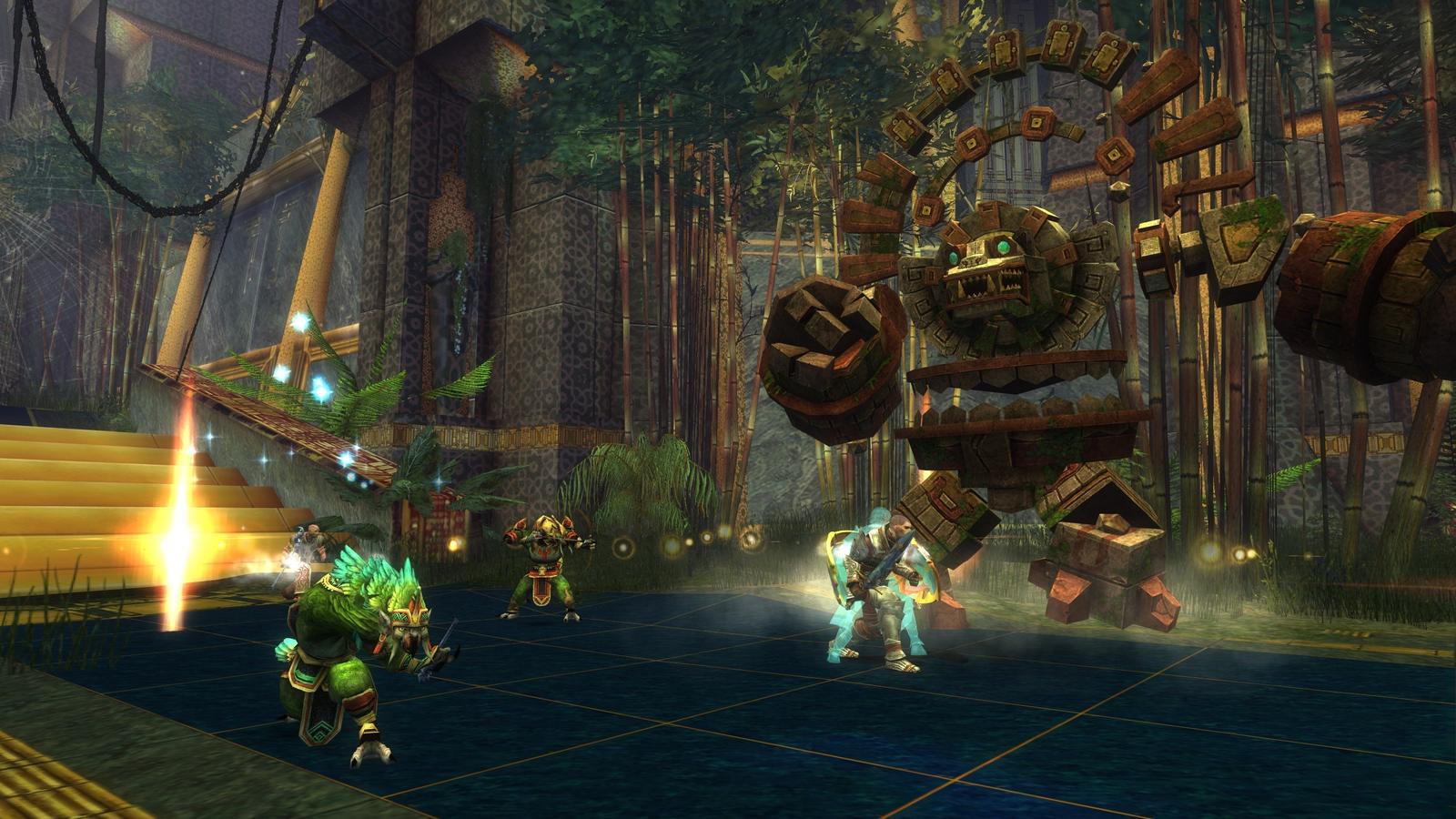
The golems are named but not explained. What the official material gives you is their name, their existence as an enemy type, and their visual register — the announcement image shows a large mechanical head with glowing eyes hanging in a jungle temple above three adventurers.
Enough to place them in Guild Wars' own history. Golems are an established part of the setting: stone and metal constructs found guarding ruins, often built by civilisations that are no longer around to maintain them. A jungle of ancient, half-swallowed stone is exactly where the setting puts that kind of thing.
The official material names the family rather than individual golems. What you can plan around is the family: constructs in a ruin, older than the people who built them, still doing whatever they were built to do.
The returning adversary
Among the store page's description lines is a sentence that has nothing to do with Nightmares or golems: prepare to face off against a familiar adversary returning from the shadows. ArenaNet does not name them there, and the announcement does not either.
The omission is deliberate marketing. Guild Wars has twenty years of antagonists, and a DLC set in the Mists has access to most of them. The line tells you the DLC's villain is a returning character rather than a new one, which is a different promise from "new enemies" — it means the story is partly a callback.
The pairing with the Cult of Odran is what makes it interesting. A cult meddling in the afterlife needs a reason, and a returning adversary is a very good reason.
There is a practical reading of the pairing too. Two families with different origins give the dungeon two kinds of encounter: one that behaves like a spirit with a history, and one that behaves like a mechanism with a purpose. That is a broader design space than a single faction of monsters, and it fits a dungeon whose maps are drawn from memories rather than from a region.
Why the enemy design fits the dungeon
The Unformed's structure and its enemies are built from the same idea. A dungeon assembled from memories should be populated by things made of memory, and the two enemy families cover both halves of that: Nightmares are memory that hurts, Ancient Golems are memory that outlasted the people who made it.
It is also why the combat reads as more than a bestiary. The store page ties the enemies to bosses — new foes and bosses including Nightmares and Ancient Golems — which suggests at least some of the dungeon's bosses come from these two families rather than from a separate cast.
The first week
The practical advice is the same as for the dungeon itself: do not expect a tier list on day one. Enemy behaviour, resistances and boss mechanics will be learned in play, and the drafting system means your answer to a given enemy changes per run.
What you can prepare is the fiction. Knowing that a Nightmare is a spirit lost to its own pain, and that a golem is a construct left running in a ruin, tells you what the two families are doing in the same dungeon: one is the cost of memory, the other is memory that never stopped working.
Checked 2026-11-05 against ArenaNet's announcement (Steam news, 2026-11-03) and the Afterlife Steam store page (app 5149500).
Next in the dossier
- Guild Wars Afterlife FAQ — Twelve short answers to the common questions.
- All guides and reading paths — Every page, with three reading routes.
- About this Afterlife guide — Who writes it, which sources it uses.